By Samantha Katz, BSN, RN, Skin Glow Collective
If you have a deeper skin tone, you've probably heard some version of this warning: be careful with lasers. Be careful with strong peels. Be careful with anything that could leave dark marks behind. That caution is real. Darker skin is more likely to develop hyperpigmentation after heat or inflammation, and a treatment that was supposed to fix one problem can create a new one.
So it's no surprise that many clients with brown and Black skin ask the same question before booking: is microneedling safe for my skin?
At Skin Glow Collective in Mount Pleasant, the answer is yes. Medical microneedling involves no heat, and it is safe for all skin types and Fitzpatrick skin types. This guide explains why, what microneedling can treat in darker skin, and what to expect when you book with Samantha Katz, BSN, RN.
Understanding skin tone and the Fitzpatrick scale
Skin care professionals often describe skin using the Fitzpatrick scale, which groups skin into six types based on how it responds to the sun. Type I always burns and never tans. Type VI is deeply pigmented and rarely burns. Types IV, V and VI are generally considered darker skin tones.
The scale matters because darker skin has more active melanin, the pigment that gives skin its color. Melanin protects against UV damage, but it also responds strongly to injury and inflammation. When darker skin is irritated, burned or inflamed, it can produce extra pigment, leaving dark marks known as post-inflammatory hyperpigmentation, or PIH. Those marks can last for months.
That's why choosing the right treatment, and the right provider, matters so much for skin of color.
Why heat-based treatments call for extra caution in darker skin
Many popular resurfacing treatments work by heating the skin. Lasers and some energy-based devices use controlled heat to damage tissue and trigger renewal. In lighter skin, this can work well. In darker skin, heat and the inflammation that follows raise the risk of pigment changes, including PIH and, in some cases, lighter patches.
Strong chemical peels carry a similar concern. In a 2022 Rutgers study of patients with darker skin, researchers noted that stronger chemical peels can permanently discolor darker skin, which is one reason they looked at microneedling as an alternative.
This doesn't mean people with darker skin can't improve texture, scarring or fine lines. It means the method matters.
Why microneedling is different
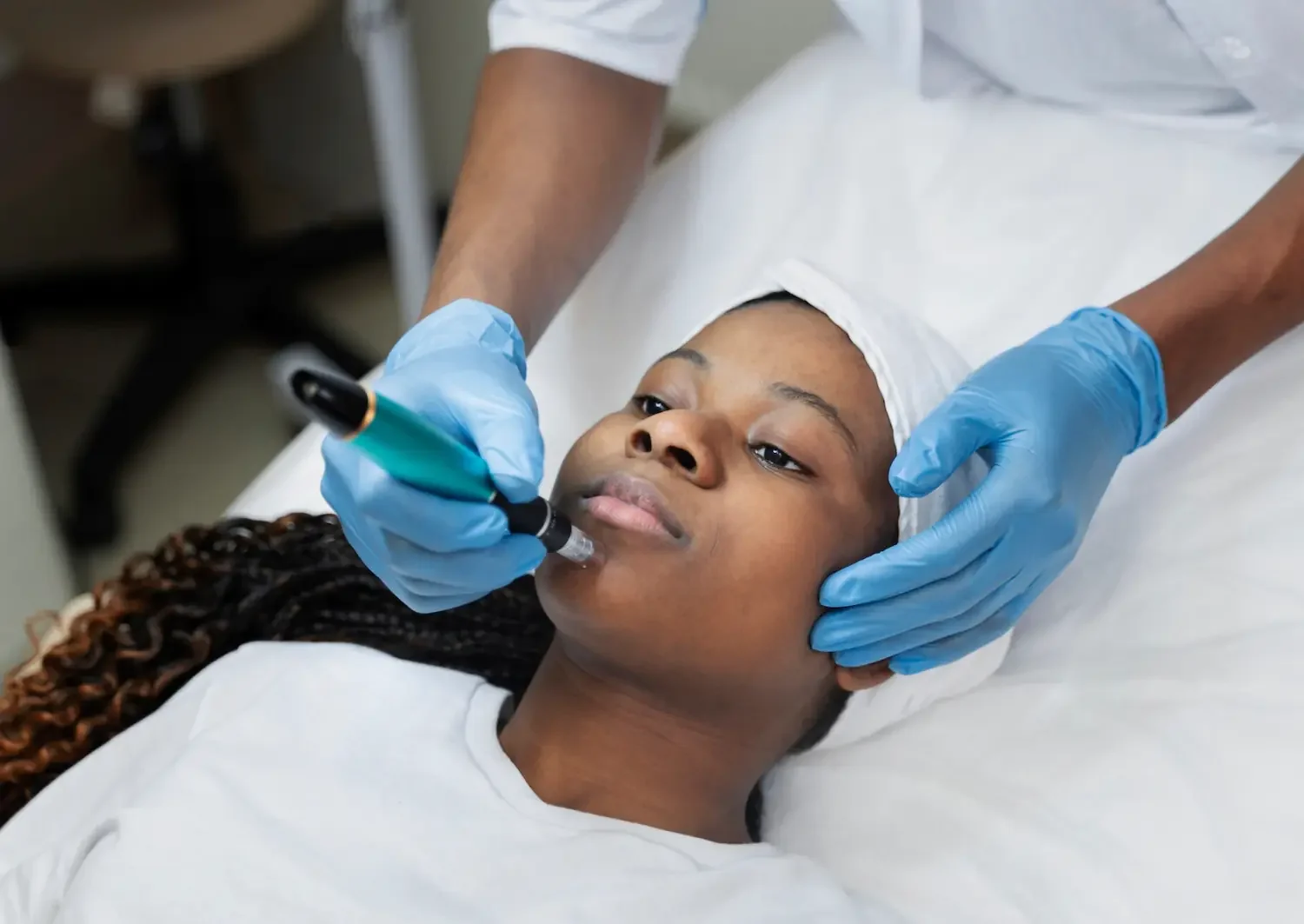
Microneedling, also called collagen induction therapy, uses a sterile cartridge with 16 fine needles to create tiny, controlled micro-channels in the skin. Your body responds to these micro-injuries by producing new collagen and elastin, the proteins that keep skin smooth and firm. Each session supports long-term renewal by improving the skin's structure from within.
The key difference is that there is no heat involved. The epidermis, the skin's top layer where pigment-producing cells live, stays largely intact. That's why microneedling is safe for all skin types and Fitzpatrick skin types.
Samantha puts it plainly: microneedling has the greatest impact on your skin for the least amount of money. Skip the lasers, trust the process of microneedling. In her words, no other procedure can offer those results without creating significant inflammation in the skin. For darker skin, less inflammation is exactly the point.

What the research shows
Microneedling has been studied specifically in people with darker skin, with encouraging results.
| Study | Who was treated | What was found |
|---|---|---|
| Rutgers University, Journal of Clinical and Aesthetic Dermatology, 2022 | 60 patients, Fitzpatrick types IV to VI, with acne scars | 73% of the microneedling group improved by at least two points on a standard acne scar scale, compared with 33% of the chemical peel group |
| Journal of Cosmetic Dermatology, 2018 | 39 patients, skin types III to V, with acne scars and pigmentation | Scars and post-acne pigmentation both improved significantly. Side effects were minor and temporary, and no patient's pigmentation got worse. |
Research is one part of the picture. The other is how the treatment is performed: the protocol, the depth, the skin preparation and the aftercare. That's where an experienced, clinically trained provider makes a difference.
What microneedling can treat in darker skin
Microneedling is a strong option for many of the concerns clients with deeper skin tones bring to the studio.
Acne scarring. Microneedling breaks down scar tissue and stimulates new collagen for smoother skin over time. A series of 3 to 6 treatments may be recommended.
Dark marks after breakouts. Microneedling helps disperse excess pigment and rebalance melanin production, revealing healthier skin layers over time.
Uneven texture and large pores. Deeper collagen support improves tone, tightness and smoothness.
Fine lines and early aging. Cumulative collagen stimulation softens wrinkles and improves elasticity.
Sun damage and melasma. Microneedling can help with uneven pigment. Melasma needs a careful, long-term plan, so read Samantha's guide to understanding melasma for more.
Microneedling plus a light chemical peel
Every microneedling appointment at Skin Glow Collective already includes a light chemical peel. Samantha's view is that the true magic happens by combining microneedling with a chemical peel that targets your specific skin concerns.
The two work on different layers. The peel works at the surface, speeding up cell turnover and clearing dull, damaged skin. Microneedling works deeper, building collagen and remodeling the skin's structure. The professional chemical peel used at Skin Glow Collective is suitable for all Fitzpatrick skin types and sensitive skin, and it addresses concerns including acne, post-inflammatory hyperpigmentation, sun damage and aging.
Learn more in Samantha's guide to microneedling and chemical peels.
What to expect at your appointment
Every microneedling session is performed start to finish by Samantha Katz, BSN, RN, using advanced protocols for safe, visible results. There are specific protocols for aging, pigmentation and acne. Your appointment includes:
Cleansing of the skin and skin analysis
Light chemical peel
Dermaplaning and gentle enzyme exfoliation
LED red light therapy
Topical numbing cream for comfort
Microneedling of the treated areas
A post-procedure kit and written post-care instructions
How to protect your results
The days around your treatment are when your skin needs the most care. For darker skin, sun protection and gentle aftercare are the best ways to prevent unwanted pigment changes. Samantha reviews all pre- and post-care instructions with you in advance. A few of the essentials:
Before your treatment
No sun exposure, tanning beds or self-tanner for 3 days before. Treatment is canceled if you are sunburned.
Stop retinoids, exfoliants, hydroquinone and benzoyl peroxide 3 days before.
Let Samantha know about any history of cold sores, keloid scarring, or Accutane use in the past 6 months.
After your treatment
Expect redness like a moderate sunburn for 24 to 48 hours. Full healing takes 5 to 7 days.
Apply a mineral SPF 30 or higher, reapply every 60 to 90 minutes outdoors, and wear a wide-brimmed hat.
Skip scrubs, toners, glycolic acid and retinoids until your skin has healed, and use only your post-treatment products for the first 4 days.
Avoid hot tubs, saunas and strenuous exercise for 2 days.
See the full instructions on the microneedling page.
How many sessions will you need?
Microneedling is not a one-and-done treatment. As Samantha says, caring for your skin is a marathon, not a sprint. Most clients see visible improvement after 1 to 2 sessions, with fuller results over a series of 3 to 6 monthly treatments. Sessions are spaced about a month apart so each round of collagen building has time to work. Unlike lasers or deep chemical peels, you cannot overdo microneedling: the more you do it, the more your skin improves.
Why skin tone experience and clinical training matter
Samantha Katz is a Registered Nurse and Licensed Aesthetician with more than 20 years in healthcare, including over a decade as a Registered Nurse in leading hospitals. Every microneedling session is performed by her personally, one-on-one, with a protocol adjusted for your skin.
That means your skin type, history and goals shape the plan, not a one-size-fits-all package. Meet Samantha.
Frequently asked questions
-
Yes. Because there is no heat involved, microneedling is safe for all skin types and Fitzpatrick skin types when performed by a trained provider. Samantha Katz, BSN, RN, adjusts every protocol for safe, effective results.
-
For most clients, Samantha recommends microneedling. It builds collagen without heat and without significant inflammation, which lowers the risk of pigment changes that heat-based treatments can cause in darker skin.
-
Any treatment that causes inflammation carries some risk in darker skin, which is why protocol, sun protection and aftercare matter. In a 2018 study of patients with skin types III to V, no patient's pigmentation got worse after microneedling. Following your pre- and post-care instructions closely helps protect your results.
-
Yes. In a 2022 Rutgers study of patients with Fitzpatrick skin types IV to VI, 73% of those treated with microneedling saw meaningful improvement in acne scars, compared with 33% of those treated with chemical peels.
-
Microneedling helps disperse excess pigment and rebalance melanin production over time. Combined with the light chemical peel included in every appointment and daily mineral SPF, it can help even out post-acne marks.
-
If you are acne prone, you may purge for the first few days after treatment. Samantha will tell you what to expect and how to care for your skin at home.
-
Expect redness similar to a moderate sunburn for 24 to 48 hours, with full healing in 5 to 7 days. Most clients return to normal activities the next day with SPF and gentle skin care.
-
Every treatment is performed personally by Samantha Katz, BSN, RN, a Registered Nurse with more than 20 years of clinical experience.
Microneedling for all skin tones in Mount Pleasant and Charleston
Skin Glow Collective is a private, one-on-one facial studio at 1031 Chuck Dawley Blvd, Suite 5, in Mount Pleasant, about 10 minutes from downtown Charleston and 15 minutes from Isle of Palms. Clients come from Mount Pleasant, Charleston, Sullivan's Island, Daniel Island, North Charleston and across the Lowcountry. Appointments are Monday to Friday, 10 am to 4 pm, by appointment only.
Your skin tone should never limit your options. Book your microneedling consultation with Samantha Katz, BSN, RN.
Sources: Rutgers study via Newswise, Journal of Cosmetic Dermatology via PubMed